

Product Detail
Home – Thymalin
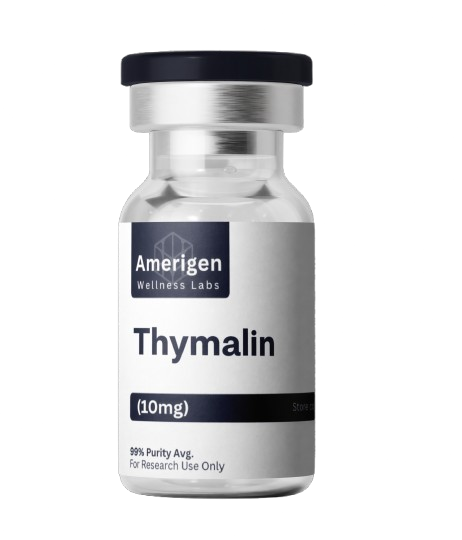
Thymalin
$59.99
Thymalin is a complex of short peptides that mimics the natural thymic factors responsible for regulating immune function. Thymalin is known for its immune-modulating and geroprotective (anti-aging) properties.
10 in stock
Physical Appearance:
White powder
Salt form:
Acetate
Sequence:
Pyr-Ala-Lys-Ser-Gln-Gly-Gly-Ser-Asn
Molecular Mass:
858.864
CAS NO.:
63958-90-7
Solubility:
Bacteriostatic water 1ml/vial
- Description
- Key Benefits / Science
- How to Use
- Reviews
Thymalin is a synthetic peptide bioregulator originally derived from calf thymus tissue. It is a complex of short peptides that mimics the natural thymic factors responsible for regulating immune function. Thymalin is known for its immune-modulating and geroprotective (anti-aging) properties.
It works by normalizing the differentiation, proliferation, and apoptosis of lymphoid cells, thereby activating cellular immunity and supporting regenerative processes throughout the body. The active short peptides within Thymalin — particularly EW, KE, and EDP — bind complementarily to specific DNA sequences or histone proteins. This interaction modulates gene expression, leading to increased synthesis of heat shock proteins (HSPs), cytokines, components of the fibrinolysis system, and proteins involved in immune cell regulation.
As a result, Thymalin helps restore immune balance, enhances antioxidant defenses, promotes tissue regeneration, and supports hemostasis. These properties make it valuable in treating various immune-related conditions, age-associated diseases, and infections. It has also been studied for potential supportive use in viral infections, including coronavirus, due to its bronchoprotective and immunocorrective effects.
Research has confirmed several important effects of Thymalin across multiple therapeutic areas:
-
- Life Extension and Geroprotection Long-term studies on elderly individuals (aged over 60) demonstrated that cyclic administration of Thymalin, alone or in combination with the pineal peptide Epithalamin, significantly improved function of the cardiovascular, endocrine, immune, and nervous systems. Over 6–8 years, treated groups experienced a 2.0–2.4-fold reduction in acute respiratory diseases and lower incidence of ischemic heart disease, hypertension, osteoarthritis, and osteoporosis. Mortality rates were reduced by 2.0–2.1 times with Thymalin alone and up to 4.1 times when combined with Epithalamin. The short peptides (EW, KE, EDP) in Thymalin influence gene expression related to immunity, cytokine production, and apoptosis, supporting overall homeostasis and healthy longevity.
-
- Immune System Support Thymalin corrects imbalances in cellular immunity, particularly in T-cell subpopulations and natural killer (NK) cell activity. It has shown benefits in patients with hyperplastic thyroid diseases, diabetic retinopathy, and post-thyroidectomy immune suppression. In HIV research, Thymalin is studied as an immune adjuvant that may enhance CD4+ T-cell recovery when combined with HAART and improve vaccine efficacy by boosting T-cell responses. It helps restore thymic function and reduces infection risk in immunocompromised states.
-
- Cancer In experimental models, Thymalin demonstrated antitumor effects, arresting tumor growth in nearly 80% of rats with transplanted sarcoma and causing regression in over 50% of cases. When combined with pulsed laser radiation, it enhanced anti-metastatic effects in melanoma and carcinoma models by increasing antibody-producing cells in the spleen. In clinical settings, combining Thymalin with plasmapheresis accelerated clinical and hematological improvement in chronic lymphoid leukemia compared to chemotherapy alone.
-
- Psoriasis When added to standard therapy, Thymalin normalized parameters of immunity and hemostasis in patients with disseminated psoriasis, leading to measurable clinical improvement.
-
- Tuberculosis In patients with progressive pulmonary tuberculosis, adding Thymalin to standard antibiotic therapy significantly increased clinical cure rates (up to 95% with individualized dosing). It was particularly effective when started early and helped restore cellular immunity in patients with comorbidities such as diabetes.
-
- Kidney Diseases In patients with exacerbated chronic glomerulonephritis, Thymalin improved kidney function, reduced inflammatory markers, and positively influenced immunologic parameters, suggesting a potential role in slowing disease progression and preserving renal function.
-
- Circadian Rhythm and Aging Age-related disruptions in circadian and circannual immune rhythms were partially restored with chronic Thymalin administration in animal models. It increased antibody production and strengthened immune responses in aging animals, potentially helping counteract increased infection susceptibility in the elderly.
-
- Heart Diseases and Atherosclerosis In rabbit models of hyperlipidemia and atherosclerosis, Thymalin exhibited hypolipidemic and anti-atherosclerotic effects. It lowered lipid levels and normalized T-suppressor cell activity and sensitivity to atherogenic lipoproteins, indicating a possible preventive role in cardiovascular disease.
-
- Postoperative States Thymalin has been shown to reduce the risk of postoperative infectious and inflammatory complications, particularly in high-risk surgeries, by supporting immune function during the vulnerable recovery period.
-
- Gum Disease (Periodontitis) Thymalin demonstrated anti-inflammatory effects and enhanced cellular immune responses in patients with periodontitis, offering a potential adjunctive therapy for this common oral condition.
-
- Anorexia Nervosa Patients with anorexia nervosa show significantly reduced thymulin activity, often linked to thymic atrophy and hormonal imbalances (especially low T3). Thymalin administration, combined with zinc supplementation, may help restore immune function and counteract thymic involution in these patients.
References
[1] V. K. Khavinson et al., “The Use of Thymalin for Immunocorrection and Molecular Aspects for Biological Activity”, 2021.
[2] V. K. Khavinson and V. G. Morozov, “Peptides of pineal gland and thymus prolong human life,” Neuro Endocrinol. Lett., vol. 24, no. 3–4, pp. 233–240, Aug. 2003.
[3] V. K. Khavinson and V. G. Morozov, “[Geroprotective effect of thymalin and epithalamin],” Adv. Gerontol. Uspekhi Gerontol., vol. 10, pp. 74–84, 2002.
[4] N. S. Lin’kova et al., “[Characteristics of the pineal gland and thymus relationship in aging],” Adv. Gerontol. Uspekhi Gerontol., vol. 24, no. 1, pp. 38–42, 2011.
[5] J. Bach et al., “Biochemical characterisation of a serum thymic factor,” Nature, vol. 266, no. 5597, pp. 55–57, Mar. 1977.
[6] A. M. Reznichenko et al., “[Changes in cell immunity indexes under the influence of thymalin, thyroxine and fibronectin in patients with hyperplastic diseases of thyroid gland before and after the surgery],” Klin. Khir., no. 12, pp. 31–33, Dec. 2001.
[7] H. D. Zhaboiedov et al., “[Evaluation of cellular and humoral immunity and individual sensitivity of T-lymphocytes to immunocorrectors in patients with diabetic retinopathy],” Lik. Sprava, no. 1, pp. 53–56, Feb. 2001.
[8] T. P. Young, “Immune mechanisms in HIV infection,” J. Assoc. Nurses AIDS Care JANAC, vol. 14, no. 6, pp. 71–75, Dec. 2003.
[9] E. Montomoli et al., “Current adjuvants and new perspectives in vaccine formulation,” Expert Rev. Vaccines, vol. 10, no. 7, pp. 1053–1061, Jul. 2011.
[10] I. I. Hrinevych et al., “[Effect of thyroxin and thymalin on proliferation and apoptosis of thymocytes in rats after thyroidectomy],” Fiziolohichnyi Zhurnal, vol. 50, no. 3, pp. 39–43, 2004.
[11] A. P. Kozlov and K. G. Moskalik, “Pulsed laser radiation therapy of skin tumors,” Cancer, vol. 46, no. 10, pp. 2172–2178, Nov. 1980.
[12] R. I. Wagner et al., “Laser radiation therapy of skin melanoma,” Strahlentherapie, vol. 157, no. 10, pp. 670–672, Oct. 1981.
[13] K. G. Moskalik, “[Effect of thymalin and epithalamin on the metastasis of experimental tumors irradiated with pulsed laser radiation],” Vopr. Onkol., vol. 33, no. 1, pp. 57–62, 1987.
[14] G. V. Zhukova et al., “Effect of Thymalin on the Tumor and Thymus under Conditions of Activation Therapy In Vivo,” Bull. Exp. Biol. Med., vol. 165, no. 1, pp. 80–83, May 2018.
[15] N. N. Tretiak et al., “[The efficacy of using thymalin and plasmapheresis in the combined treatment of patients with chronic lympholeukemia],” Lik. Sprava, no. 2, pp. 93–96, Apr. 1998.
[16] T. F. Babenko et al., “[Thymalin in the combined treatment of patients with chronic lympholeukemia],” Vrach. Delo, no. 3, pp. 47–49, Mar. 1989.
[17] M. P. Isaeva et al., “[The effect of thymalin on indices of immunity and hemostasis in patients with disseminated forms of psoriasis],” Vestn. Dermatol. Venerol., no. 10, pp. 42–43, 1989.
[18] A. A. Maslennikov et al., “[Immunological correction in progressive pulmonary tuberculosis],” Probl. Tuberk. Bolezn. Legk., no. 9, pp. 30–33, 2007.
[19] L. A. Ivanova, “[The use of thymalin in the combined chemotherapy of patients with infiltrative destructive pulmonary tuberculosis],” Vrach. Delo, no. 10, pp. 57–59, Oct. 1989.
[20] M. A. Karachunskiĭ et al., “[Specific features of cellular immunity of pulmonary tuberculosis in patients with diabetes mellitus],” Probl. Tuberk., no. 6, pp. 59–60, 1997.
[21] G. V. Budazhabon et al., “[Immunogenesis and hemostasis in patients with exacerbated chronic glomerulonephritis treated with thymalin],” Ter. Arkh., vol. 56, no. 10, pp. 62–66, 1984.
[22] I. F. Labunets’, “[Age-related changes in circadian and circannual fluctuations of the immune response and the number of cells in lymphoid organs of animals: a possible connection to thymic factors],” Fiziolohichnyi Zhurnal, vol. 47, no. 5, pp. 54–62, 2001.
[23] V. E. Ryzhenkov et al., “[Effect of thymalin on the development of experimental hyperlipidemia and atherosclerosis],” Vopr. Med. Khim., vol. 34, no. 1, pp. 51–56, Feb. 1988.
[24] Z. S. Zhumadilov and R. P. Terekhova, “[Use of thymalin for preventing postoperative suppurative and inflammatory complications],” Klin. Khirurgiia, no. 1, pp. 36–38, Jan. 1985.
[25] B. I. Kuznik et al., “[Use of thymalin in treating periodontitis patients],” Stomatologiia (Sofiia), vol. 64, no. 1, pp. 20–22, Feb. 1985.
[26] S. Wade et al., “Thymulin (Zn-facteur thymique serique) activity in anorexia nervosa patients,” Am. J. Clin. Nutr., vol. 42, no. 2, pp. 275–280, Aug. 1985.
Reviews
There are no reviews yet.