

Product Detail
Home – LL37
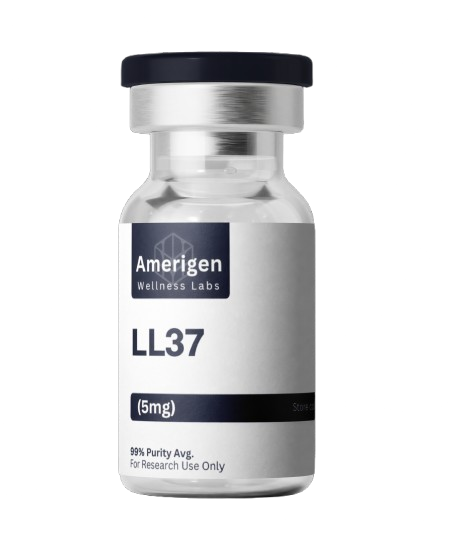
LL37
Original price was: $80.00.$75.00Current price is: $75.00.
Laboratory and preclinical studies show LL-37 effectively kills a wide range of bacteria (including resistant strains), fungi, and viruses by disrupting their membranes and inhibiting biofilms. It neutralizes endotoxins, modulates immune responses, and promotes wound healing by stimulating cell migration, angiogenesis, and tissue repair in animal models.
10 in stock
- Description
- Key Benefits / Science
- How to Use
- Reviews
LL-37 is the most extensively studied human antimicrobial peptide. It is a 37-amino-acid cationic peptide naturally produced in the human body, primarily by polymorphonuclear leukocytes (neutrophils), as well as in skin, bone marrow, and macrophages. Discovered in the late 1990s during research on innate immunity mechanisms, LL-37 is generated by proteolytic cleavage of a larger precursor protein known as hCAP-18 (human cathelicidin antimicrobial protein of 18 kDa). This peptide serves as a critical frontline defense against microbial pathogens.
LL-37 exhibits broad-spectrum activity, capable of eliminating bacteria, viruses, fungi, and molds. Beyond its direct antimicrobial effects, it exerts anti-inflammatory properties, promotes tissue repair, and stimulates angiogenesis. These multifaceted actions make LL-37 a promising therapeutic candidate for conditions involving chronic inflammation, autoimmune diseases, cancer, and infections caused by multidrug-resistant bacteria. It is increasingly investigated as a potential alternative or adjunct to conventional antibiotics.
LL-37 acts through a dual mechanism: it directly disrupts bacterial membranes and simultaneously modulates the immune response. In one study, a recombinant form called GLL-37 was produced in E. coli using a proprietary expression system, yielding high quantities. However, this recombinant version showed significantly reduced antibacterial activity compared to synthetic LL-37. The difference was attributed to secondary structure variations — GLL-37 adopted an α-helical conformation that impaired effective interaction with bacterial membranes, whereas native/synthetic LL-37 maintains a random coil structure essential for membrane disruption.
Research has revealed several important effects of LL-37 across various disease contexts:
- Inflammatory and Autoimmune Diseases LL-37 plays a complex, context-dependent role in inflammatory and autoimmune disorders such as psoriasis, systemic lupus erythematosus (SLE), rheumatoid arthritis (RA), and atherosclerosis. It modulates immune responses by enhancing production of IFN-α and IL-18, reducing keratinocyte apoptosis, altering chemotaxis of neutrophils and eosinophils, and downregulating TLR4 signaling. It can promote pro-inflammatory responses in resting cells while dampening inflammation in activated cells, suggesting a homeostatic fine-tuning function. LL-37 influences monocyte-to-macrophage differentiation toward a pro-inflammatory M1 phenotype, modulates cytokine profiles (e.g., downregulating IL-10 while enhancing IL-12p40), and acts as a chemoattractant via the FPR2 receptor to support tissue regeneration and wound healing. It has also been linked to reduced atherosclerotic plaque volume in some models.
- Antimicrobial Activity As a key component of the skin’s innate immune system, LL-37 is rapidly upregulated during infection and inflammation. In psoriasis lesions, LL-37 and human β-defensin-2 (HBD-2) are highly expressed and work synergistically against Staphylococcus aureus, whereas their levels are lower in atopic dermatitis, contributing to increased infection risk. LL-37 binds to lipopolysaccharide (LPS) on Gram-negative bacteria, disrupting membrane integrity. It is active against both Gram-negative and Gram-positive bacteria (including enhancing lysozyme’s effect on S. aureus) and shows promise in sepsis management. Truncated fragments of LL-37 (e.g., fragments 106 and 110) retain antimicrobial and LPS-neutralizing activity with lower cytotoxicity and better serum stability, making them attractive for therapeutic development.
- Pulmonary Diseases In the airways, LL-37 helps neutralize LPS from bacteria and environmental sources, reducing pro-inflammatory stimuli linked to asthma, COPD, and hypersensitivity pneumonitis. It promotes epithelial cell proliferation, migration, wound closure, and angiogenesis in a serum-dependent manner via EGFR, G-protein-coupled receptors, and MAP/ERK pathways. These properties position LL-37 as a potential regulator of respiratory epithelium repair and a candidate for inhaled therapy in inflammatory lung conditions.
- Arthritis LL-37 is upregulated in rheumatoid arthritis synovial tissue, particularly in neutrophils, macrophages, and osteoclasts. While its exact role is debated (it may reflect inflammation rather than cause it), animal models show that derivatives such as the LL-37-derived peptide IG-19 can alleviate collagen-induced arthritis symptoms, reduce autoantibody levels, decrease inflammatory cell infiltration, and protect cartilage. IG-19 also suppresses IL-32-driven inflammation by modulating Src kinase and MKP-1 pathways, reducing pro-inflammatory cytokines (TNF-α, IL-1β) while increasing anti-inflammatory IL-1RA. Studies in cathelicidin-deficient models suggest other peptides may compensate for its absence, and LL-37 does not appear to drive disease progression directly.
- Cancer LL-37 exhibits context-dependent effects in oncology. It may promote tumor growth in some cancers (e.g., lung, breast, prostate) but shows anti-cancer activity in others, including colorectal, gastric, and certain hematological malignancies. Its expression can be induced by vitamin D, enhancing anti-tumor macrophage activity. Responses vary due to differential receptor activation on cancer cells.
- Angiogenesis LL-37 strongly promotes blood vessel formation by stimulating prostaglandin E2 (PGE2) synthesis in endothelial cells through the cPLA2 → COX-1 → PGE2 pathway, activating the EP3 receptor. This effect is dose-dependent, peaks around 4 hours, and is sensitive to COX-1 inhibition (e.g., by aspirin). While beneficial for wound healing and tissue regeneration, this mechanism may also contribute to pathological angiogenesis in tumors.
References
[1] Antonín Pavelka, Lukáš Vacek, Adam Norek, Šárka Kobzová, Lubomír Janda, “Recombinant production of human antimicrobial peptide LL-37 and its secondary structure,” Volume 79, pages 263–273, (2024)
[2] J. M. Kahlenberg and M. J. Kaplan, “Little peptide, big effects: the role of LL-37 in inflammation and autoimmune disease,” J. Immunol. Baltim. Md 1950, vol. 191, no. 10, Nov. 2013.
[3] D. S. Alexandre-Ramos et al., “LL-37 treatment on human peripheral blood mononuclear cells modulates immune response and promotes regulatory T-cells generation,” Biomed. Pharmacother. Biomedecine Pharmacother., vol. 108, pp. 1584–1590, Dec. 2018.
[4] P. Y. Ong et al., “Endogenous antimicrobial peptides and skin infections in atopic dermatitis,” N. Engl. J. Med., vol. 347, no. 15, pp. 1151–1160, Oct. 2002.
[5] C. D. Ciornei, T. Sigurdardóttir, A. Schmidtchen, and M. Bodelsson, “Antimicrobial and chemoattractant activity, lipopolysaccharide neutralization, cytotoxicity, and inhibition by serum of analogs of human cathelicidin LL-37,” Antimicrob. Agents Chemother., vol. 49, no. 7, pp. 2845–2850, Jul. 2005.
[6] X. Chen et al., “Synergistic effect of antibacterial agents human β-defensins, cathelicidin LL-37 and lysozyme against Staphylococcus aureus and Escherichia coli,” J. Dermatol. Sci., vol. 40, no. 2, pp. 123–132, Nov. 2005.
[7] M. Golec, “Cathelicidin LL-37: LPS-neutralizing, pleiotropic peptide,” Ann. Agric. Environ. Med. AAEM, vol. 14, no. 1, pp. 1–4, 2007.
[8] R. Shaykhiev et al., “Human endogenous antibiotic LL-37 stimulates airway epithelial cell proliferation and wound closure,” Am. J. Physiol. Lung Cell. Mol. Physiol., vol. 789, no. 5, pp. L842-848, Nov. 2005.
[9]–[16] (Arthritis-related studies as originally numbered): Hoffmann et al. (2013), Kienhöfer et al. (2014), Chow et al. (2014), Choi et al. (2014), Zhu et al. (2011), Brown et al. (2011), Otte et al. (2009), Otte et al. (2008).
[17] X. Chen et al., “Roles and Mechanisms of Human Cathelicidin LL-37 in Cancer,” Cell. Physiol. Biochem. Int. J. Exp. Cell. Physiol. Biochem. Pharmacol., vol. 47, no. 3, pp. 1060–1073, 2018.
[18] Salvado M. Dolores et al., “Cathelicidin LL-37 Induces Angiogenesis via PGE2–EP3 Signaling in Endothelial Cells, In Vivo Inhibition by Aspirin,” Arterioscler. Thromb. Vasc. Biol., vol. 33, no. 8, pp. 1965–1972, Aug. 2013.
[19] D. Xhindoli et al., “The human cathelicidin LL-37 — A pore-forming antibacterial peptide and host-cell modulator,” Biochim. Biophys. Acta BBA – Biomembr., vol. 1858, no. 3, pp. 546–566, Mar. 2016.
Reviews
There are no reviews yet.