

Product Detail
Home – GHK-cu 50mg
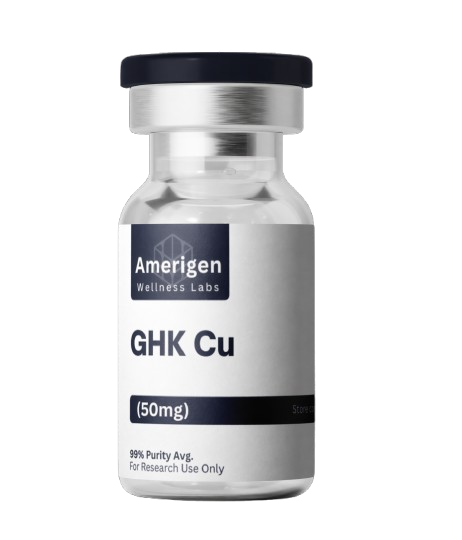
GHK-cu 50mg
$44.99
It is widely recognized for its regenerative properties in skin and hair care, where it improves skin firmness, elasticity, and clarity, reduces fine lines and wrinkles, repairs the skin barrier, and promotes wound healing. Beyond cosmetics, GHK-Cu demonstrates anti-inflammatory, antioxidant, and tissue-protective actions.
52 in stock
Physical Appearance:
Blue powder
Sequence:
Gly-His-Lys(Cu2+)
Molecular Mass:
340.38
CAS NO.:
300801-03-0
- Description
- Key Benefits / Science
- How to Use
- Reviews
GHK-Cu (Glycyl-L-Histidyl-L-Lysine Copper Complex) is a naturally occurring tripeptide found in human plasma, saliva, urine, and tissues. Discovered in 1973, this small copper-binding peptide is released during tissue injury and plays a significant role in protection, repair, and regeneration.
GHK-Cu binds copper(II) ions with high affinity, facilitating copper transport and metabolism while exerting powerful biological effects. It is widely recognized for its regenerative properties in skin and hair care, where it improves skin firmness, elasticity, and clarity, reduces fine lines and wrinkles, repairs the skin barrier, and promotes wound healing. Beyond cosmetics, GHK-Cu demonstrates anti-inflammatory, antioxidant, and tissue-protective actions.
Recent genomic research using the Broad Institute’s Connectivity Map has shown that GHK-Cu can up- and down-regulate thousands of human genes, effectively resetting gene expression patterns from a diseased or aged state toward a healthier, younger profile. Its levels naturally decline with age, making supplementation or topical application particularly relevant for regenerative and anti-aging purposes.
Research has confirmed multiple regenerative, protective, and therapeutic effects of GHK-Cu across various models:
- Skin Healing and Regeneration: GHK-Cu accelerates wound healing by stimulating collagen, elastin, and glycosaminoglycan synthesis while modulating metalloproteinases and their inhibitors. It promotes fibroblast activity, angiogenesis, and extracellular matrix remodeling. In cosmetic applications, it tightens loose skin, improves elasticity and firmness, reduces wrinkles, fine lines, photodamage, and hyperpigmentation. Studies show GHK-Cu encapsulated in liposomes accelerates scald wound healing in mice by enhancing cell proliferation, vascular endothelial growth factor (VEGF), and fibroblast growth factor expression. It also helps prevent hypertrophic scarring by modulating TGF-β1 and IGF-2 pathways.
- Antimicrobial and Wound Infection Control: GHK-Cu and its fatty acid conjugates exhibit antimicrobial activity against Gram-positive and Gram-negative bacteria (including Staphylococcus aureus, Escherichia coli, and Pseudomonas aeruginosa) as well as certain fungi. In a multicenter clinical trial on diabetic neuropathic ulcers, topical GHK-Cu (lamin Gel) significantly improved ulcer closure rates (98.5% vs 60.8% in controls), accelerated healing (especially in larger ulcers), and reduced infection rates from 34% to 7%. In rat models of ischemic open wounds, GHK-Cu reduced wound area, lowered inflammatory markers (TNF-α, MMP-2, MMP-9), and enhanced healing compared to controls.
- Nervous System and Cognition: GHK-Cu shows neuroprotective effects and may help counteract age-related cognitive decline. It modulates gene expression relevant to nervous system function and reduces central nervous system inflammation. In rat models of intracerebral hemorrhage (ICH), GHK pretreatment improved neurological outcomes, reduced brain edema, and inhibited neuronal apoptosis via the miR-339-5p/VEGFA pathway and p38 MAPK signaling. It also supports angiogenesis and nerve outgrowth in the brain.
- Protection Against Chemotherapy Side Effects and Lung Injury: GHK-Cu demonstrates protective effects against bleomycin-induced pulmonary fibrosis in mice by suppressing TGF-β1/Smad-mediated epithelial-to-mesenchymal transition (EMT), reducing inflammatory cytokines (TNF-α, IL-6), and balancing MMP-9/TIMP-1 levels. It also ameliorates lipopolysaccharide (LPS)-induced acute lung injury (ALI) by decreasing reactive oxygen species (ROS), increasing superoxide dismutase (SOD) activity, and inhibiting NF-κB and p38 MAPK pathways. These findings suggest potential as an adjunct to reduce lung damage during certain chemotherapies or in inflammatory lung conditions like ARDS.
- Pain Reduction: In rat models, GHK-Cu administered intraperitoneally exhibited analgesic and anti-aggressive effects in pain-induced aggressive-defensive behavior (foot-shock model). The L-lysine residue appears key to these effects. Research indicates GHK-Cu and related glyprolines may offer non-addictive alternatives for pain management with fewer side effects than traditional opioids or NSAIDs.
References
[1] L. Pickart, J. M. Vasquez-Soltero, and A. Margolina, “GHK Peptide as a Natural Modulator of Multiple Cellular Pathways in Skin Regeneration,” BioMed Res. Int., vol. 2015, p. 648108, 2015.
[2] A. Gruchlik, E. Chodurek, and Z. Dzierzewicz, “Effect of GLY-HIS-LYS and its copper complex on TGF-β secretion in normal human dermal fibroblasts,” Acta Pol. Pharm., vol. 71, no. 6, pp. 954–958, Dec. 2014.
[3] L. Pickart and A. Margolina, “Regenerative and Protective Actions of the GHK-Cu Peptide in the Light of the New Gene Data,” Int. J. Mol. Sci., vol. 19, no. 7, Jul. 2018.
[4] X. Wang et al., “GHK-Cu-liposomes accelerate scald wound healing in mice by promoting cell proliferation and angiogenesis,” Wound Repair Regen., vol. 25, no. 2, pp. 270–278, 2017.
[5] M. Kukowska, M. Kukowska-Kaszuba, and K. Dzierzbicka, “In vitro studies of antimicrobial activity of Gly-His-Lys conjugates as potential and promising candidates for therapeutics in skin and tissue infections,” Bioorg. Med. Chem. Lett., vol. 25, no. 3, pp. 542–546, Feb. 2015.
[6] G. D. Mulder et al., “Enhanced healing of ulcers in patients with diabetes by topical treatment with glycyl-l-histidyl-l-lysine copper,” Wound Repair Regen., vol. 2, no. 4, pp. 259–269, Oct. 1994.
[7] S. O. Canapp et al., “The effect of topical tripeptide-copper complex on healing of ischemic open wounds,” Vet. Surg., vol. 32, no. 6, pp. 515–523, Dec. 2003.
[8] L. Pickart, J. M. Vasquez-Soltero, and A. Margolina, “The Effect of the Human Peptide GHK on Gene Expression Relevant to Nervous System Function and Cognitive Decline,” Brain Sci., vol. 7, no. 2, Feb. 2017.
[9] H. Zhang, Y. Wang, and Z. He, “Glycine-Histidine-Lysine (GHK) Alleviates Neuronal Apoptosis Due to Intracerebral Hemorrhage via the miR-339-5p/VEGFA Pathway,” Front. Neurosci., vol. 12, p. 644, 2018.
[10] X.-M. Zhou et al., “GHK Peptide Inhibits Bleomycin-Induced Pulmonary Fibrosis in Mice by Suppressing TGFβ1/Smad-Mediated Epithelial-to-Mesenchymal Transition,” Front. Pharmacol., vol. 8, p. 904, 2017.
[11] J.-R. Park et al., “The tri-peptide GHK-Cu complex ameliorates lipopolysaccharide-induced acute lung injury in mice,” Oncotarget, vol. 7, no. 36, pp. 58405–58417, Sep. 2016.
[12] L. А. Sever’yanova and M. E. Dolgintsev, “Effects of Tripeptide Gly-His-Lys in Pain-Induced Aggressive-Defensive Behavior in Rats,” Bull. Exp. Biol. Med., vol. 164, no. 2, pp. 140–143, Dec. 2017.
[13] L. А. Sever’yanova and D. V. Plotnikov, “Binding of Glyprolines to L-Arginine Inverts Its Analgesic and Antiagressogenic Effects,” Bull. Exp. Biol. Med., vol. 165, no. 5, pp. 621–624, Sep. 2018.
Dosing
•1–2 mg/day
Cycle Length
•8–12 weeks
Vials Needed
•1.5 mg/day × 56 days ≈ 84 mg → 2 vials
Reviews
There are no reviews yet.