

Product Detail
Home – CJC-1295 10mg (no DAC)
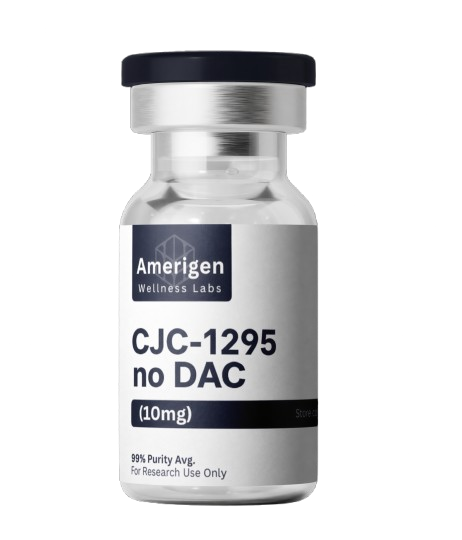
CJC-1295 10mg (no DAC)
$79.99
CJC-1295, without DAC (also known as Mod GRF 1-29) is a synthetic analog of the first 29 amino acids of natural Growth Hormone Releasing Hormone (GHRH). It is widely recognized for its ability to stimulate the pituitary gland to release growth hormone.
10 in stock
Physical Appearance:
White powder
Salt form:
Acetate
Sequence:
Tyr-D-Ala-Asp-Ala-Ile-Phe-Thr-Gln-Ser-Tyr-Arg-Lys-Val-Leu-Ala-Gln-Leu-Ser-Ala-Arg-Lys-Leu-Leu-Gln-Asp-Ile-Leu-Ser-Arg-NH2
Molecular Mass:
3367.9
CAS NO.:
863288-34-0
Solubility:
Sterile / Bacteriostatic water 1ml/vial
- Description
- Key Benefits / Science
- How to Use
- Reviews
CJC-1295, without DAC (also known as Mod GRF 1-29) is a synthetic analog of the first 29 amino acids of natural Growth Hormone Releasing Hormone (GHRH). Early research discovered that the biologically active core of GHRH resides within the first 29 amino acids, leading to the development of CJC-1295, commonly known as Sermorelin. However, native CJC-1295 has an extremely short half-life (less than 10 minutes) due to rapid enzymatic degradation.
To overcome this limitation, scientists created modified versions by substituting specific amino acids with more enzymatically stable counterparts. These changes significantly increased the peptide’s resistance to breakdown, improved its binding affinity to GHRH receptors, and extended its half-life. Originally referred to as tetrasubstituted GRF 1-29, the compound was later termed Mod GRF 1-29 in 2008. Today, Mod GRF 1-29 is widely recognized for its ability to stimulate the pituitary gland to release growth hormone in a more sustained and physiologically relevant manner compared to the unmodified version.
Research on CJC-1295, without DAC (Mod GRF 1-29) and related GHRH analogs has explored their effects beyond simple growth hormone release, revealing several potential therapeutic applications as well as important considerations:
-
- Gastrointestinal Effects Studies investigating GHRH analogs for possible use in conditions such as Crohn’s disease and short bowel syndrome identified unexpected gastrointestinal side effects in non-rodent models. In monkeys, prolonged infusion of certain potent analogs caused severe diarrhea, an effect not observed in rats. Further investigation linked this to interaction with the vasoactive intestinal peptide receptor (VPAC1-R), which is abundant in the gastrointestinal tract and regulates smooth muscle motility. Structural modifications in GRF analogs were shown to markedly alter receptor affinity and activity, highlighting the importance of species-specific receptor interactions when developing therapeutic peptides to minimize unwanted GI effects.
-
- Diabetes and Heart Function GHRH agonists, including analogs of Mod GRF 1-29, have demonstrated beneficial effects beyond pituitary stimulation. They can promote pancreatic β-cell proliferation and improve metabolic function, suggesting potential utility in diabetes management. These agonists have also been shown to enhance islet engraftment following transplantation. In cardiac models, GHRH agonists improved ejection fraction, reduced infarct size, and attenuated cardiac hypertrophy, indicating possible applications in heart attack recovery and heart failure treatment. Additional research points to neuroprotective effects in diabetic retinopathy, accelerated wound healing, immune cell activation, and central nervous system activity.
- Growth Hormone Response in Hypothyroidism Patients with primary hypothyroidism often exhibit impaired growth hormone (GH) release. A clinical study involving 14 patients (aged 26–60) evaluated GH responses to GRF 1-29 stimulation before and during thyroxine (T4) replacement therapy (150 µg/day). Results showed that T4 therapy significantly enhanced GH responses to GRF in the majority of patients and in the group overall, as confirmed by area-under-the-curve measurements. These findings indicate that thyroid hormone replacement improves somatotroph cell responsiveness to GHRH stimulation, which may have implications for optimizing treatment in hypothyroid patients using Mod GRF 1-29.
References
[1] T. Ito et al., “GI side-effects of a possible therapeutic GRF analogue in monkeys are likely due to VIP receptor agonist activity,” Peptides, vol. 22, no. 7, pp. 1139–1151, Jul. 2001.
[2] M. Waelbroeck, P. Robberecht, D. H. Coy, J.-C. Camus, P. D. Neef, and J. Christophe, “Interaction of Growth Hormone-Releasing Factor (GRF) and 14 GRF Analogs with Vasoactive Intestinal Peptide (VIP) Receptors of Rat Pancreas. Discovery of (N-Ac-Tyr1,D-Phe2)-GRF(1-29)-NH2 as a VIP Antagonist,” Endocrinology, vol. 116, no. 6, pp. 2643–2649, Jun. 1985.
[3] A. V. Schally, X. Zhang, R. Cai, J. M. Hare, R. Granata, and M. Bartoli, “Actions and potential therapeutic applications of growth hormone-releasing hormone agonists,” Endocrinology.
[4] R. Valcavi et al., “Growth Hormone Responses to Grf 1–29 in Patients with Primary Hypothyroidism Before and During Replacement Therapy with Thyroxine,” Clin. Endocrinol. (Oxf.), vol. 24, no. 6, pp. 693–698, 1986.
Reviews
There are no reviews yet.